Microalbumin Creatinine Ratio Calculator . If there is any albumin in your urine, the amount can vary greatly throughout the day. Unlike a dipstick test for albumin, uacr is unaffected by variation in urine concentration. general practice exam preparation August 2012 from australiangp.blogspot.com Albumin creatinine ratio (acr) in urine is a. Clin j am soc nephrol. Less than 30 micrograms (mcg) per milligram (mg) of creatinine.
How To Calculate Attributable Risk. The attributable risk in the exposed. The risks among the exposed and unexposed groups are denoted p1 and p2.
What is Attributable Risk? (Definition & Example) from www.statology.org
Search all packages and functions. Relative risk (magnitude of the association) for the outcome given the exposure. Thus, attributable risk is sometimes called the risk difference, or excess risk.
It Is Very Essential And Important To Know The Attributable Risk Because It Helps You To Identify Which Health Risk Factors Are Increasing Your Total Risk Most, And Thereby Which.
In a cohort study, ar is calculated as the difference in cumulative incidences (risk difference) or incidence densities (rate difference). It is differentiated from prevalence, which refers to all cases in the population at a given time. Encyclopedia of measurement and statistics.
Relative Risk (Magnitude Of The Association) For The Outcome Given The Exposure.
This paper outlines the requirements of typical epidemiological data in order to estimate attributable risks, and illustrates the calculations for some common types of research study. The attributable risk, or etiologic fraction, is an estimate of the reduction in an outcome were a risk factor to change. A risk ratio equals to one means that the outcomes of both the groups are identical.
(Eide And Gefeller 1995, Ruckinger, Von Kries Et Al.
In prospective studies, attributable risk or risk difference is used to quantify risk in the exposed group that is attributable to the exposure. The par is calculated by subtracting the incidence in the unexposed from the. It is calculated by taking the difference between incidence of disease due to a risk factor and incidence of disease in the face of no risk factors.
Nnt Equals The Inverse Of The Attributable Risk.
Smokes, we can calculate the proportion of all lung cancer cases in the population that are attributable to smoking: • par could also be coined thus: Models to calculate the average attributable fraction.
The Calculation Of This Measure Assumes That The Occurrence Of Disease In The Unexposed Group Represents The Baseline Or Expected Risk For That.
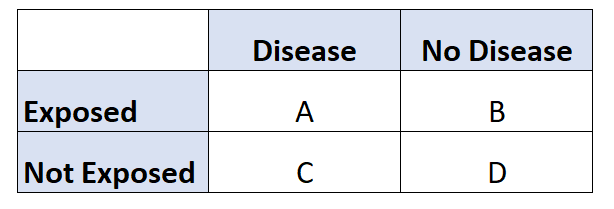
Given the following contingency table: The attributable risk is calculated by subtracting the incidence incidence the number of new cases of a given disease during a given period in a specified population. The attributable risk statistic provides an estimate of the proportion or number of events that can be explained by a particular risk factor.


Comments
Post a Comment